

Saeed Karimzadeh
In 2022, my research life looked like a tangled scribble, curious ideas, and no clear path. By November 2025, that scribble became a publication in Communications Earth & Environment. The journey from chaos to clarity took about three years and many weekends.
I’m Saeed Karimzadeh. I studied at Shiraz University, Politecnico di Milano, and completed my PhD at the University of California Davis. Alongside academic life, I was a DJ (mixing tracks at clubs and events). Surprisingly, DJing and research share a core skill: pattern recognition. You listen carefully, adjust constantly, and know when something is offbeat.
Below, I’ll take you through my personal journey of progressing towards becoming independent in research and what I learned.
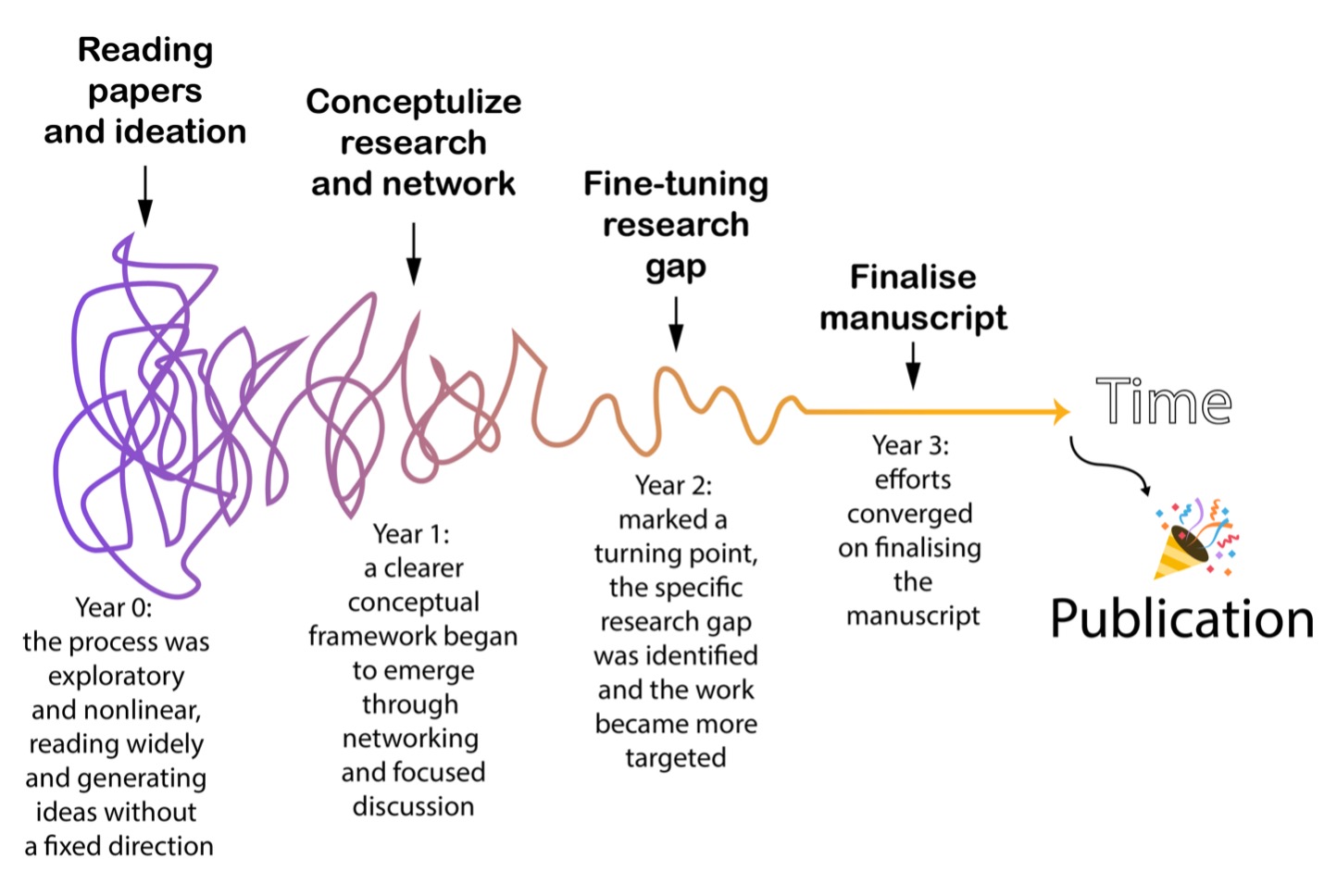
From a journal’s perspective, a researcher who is not affiliated with any institution or company may list their affiliation as an “Independent Researcher”. For me, an independent researcher in an early-stage career is not someone detached from institutions, but someone who takes intellectual ownership of a question and pursues it with discipline even when there is no formal obligation to do so. Many research projects are pursued because they are assigned, funded, or convenient. Even when researchers are genuinely interested, their work is often shaped by funding priorities, institutional goals, or the expectations of supervisors.
Independent research begins from the opposite place: pure curiosity. In my opinion, the defining feature of independent research is obsession. It is the point where a subject stops feeling like a job and becomes something you cannot leave alone. You keep returning to it, not because anyone is asking you to, but because the questions themselves refuse to let go.
It’s the same feeling that keeps you binge-watching a series like Game of Thrones: you cannot walk away because you need to know what happens next. The difference is that, in research, the mystery is real. You are not following a story someone else has written, you are trying to uncover something that nobody fully understands yet.
Back in 2022, my curiosity was evapotranspiration (water loss from land through soil evaporation and plant transpiration). Evapotranspiration drives the global water cycle by returning precipitation to the atmosphere. During my PhD, I read a paper on meteorological drivers of reference evapotranspiration in California by Ahmadi et al. (2022). The methodology fascinated me. I wondered: What if this approach were scaled globally? That question became a side project, built during evenings and weekends because it wasn’t funded or part of my PhD dissertation.
What I learned from the process
Independent research is not merely a choice; it is a process that shapes and develops you. Here are five lessons that shaped me into a new kind of researcher, distilled from three years in the making. These reflect my own experience, and your journey may be smoother, bumpier, or simply different.
- Start with Intellectual Excitement (year 0)
Independent research competes with your free time, energy, and sometimes sleep. If the topic does not genuinely excite you, motivation will evaporate. Curiosity must be strong enough to survive fatigue.
“Ask yourself: Would I still think about this question if no one required me to? If the answer is yes, you are on the right track.”
- Mind the “Limitations” Section (year 0 to 2)
Most people skim to the results and conclusions of scientific papers. I learned to intentionally read limitations and future directions slowly. That is where authors reveal uncertainty, constraints, and unresolved tensions. When you read enough papers this way, patterns emerge. Patterns reveal gaps. Gaps become research questions.
“Connect the dots between the limitations identified across the papers you’ve read.”
- Expose Your Work to Scrutiny Early (year 1)
Conferences like American Geophysical Union (AGU) or European Geosciences Union (EGU) are not only for polished presentations. They are testing grounds. Share preliminary results. Invite criticism. Engage in uncomfortable conversations.
In 2023, at AGU in San Francisco, I had the chance to discuss this directly with two leading experts in the field: Prof. Joshua Fisher and Prof. Dennis Baldocchi. We shared preliminary results with Joshua and during a discussion about a retracted paper, he remarked, “The author forgot the Earth is not flat.” It was humorous but deeply instructive. I revisited our spatial calculations to ensure we accounted properly for geographic distortions. That one sentence sharpened our rigour. Later, feedback from Dennis helped us clarify blind spots and refine the research gap. A single comment like the reminder about Earth’s curvature can prevent foundational mistakes. Experts see blind spots you cannot see because you are too close to your own work. Even the most solitary research is quietly shaped by the scientific community through the papers you build on, the reviewers who sharpen your thinking, and the peers who challenge your assumptions.
- Be Patient with Depth (year 0 to 3)
Understanding a field deeply enough to contribute meaningfully takes time. This includes engaging with recent articles and academic papers that touch on the topic peripherally rather than addressing it directly. Reading across adjacent areas proves particularly valuable for identifying blind spots, gaps in understanding that a more targeted literature review may fail to reveal. There is a difference between producing results and developing insight.Insight requires digestion. It requires revisiting assumptions, re-running analyses, and sometimes starting over.
“Three years once felt long for me. Now it feels appropriate.”
- Treat Criticism as Calibration (year 2 to 3)
Co-author feedback can be demanding. Reviewers’ comments can be humbling. Revisions can feel repetitive. But every critique is calibration. Each round refines clarity, strengthens logic, and reduces bias.
“If you detach your ego from your equations, criticism becomes collaboration.”
Looking back, the early chaos was necessary (year 0; see figure). The scribbles were not failures; they were explorations. Slowly, the scribble gained structure (years 1 and 2), and we published (year 3) the article “Climate change has increased global evaporative demand except in South Asia”. Independence did not mean working alone; it meant choosing to pursue a question because it mattered to me. The journey unfolded across three universities (UC Davis, TU Delft, and Aalto) and six countries: the United States, the Netherlands, Italy, Iran, Turkey, and Finland. No supervisor demanded it. No deadline was enforced. Every step was pulled forward by the same quiet force: curiosity.
And just like DJing, good research is not about playing louder. It is about listening carefully, adjusting thoughtfully, and knowing when the rhythm finally makes sense.
Side note: Irrigation on a massive scale across South Asia has had a surprising cooling effect on the atmosphere, reducing the air’s “thirst” for water at a time when the opposite is happening almost everywhere else on Earth. See the paper for a deeper dive.
Acknowledgements
A special thank you to Arman Ahmadi, whose mentorship brought new perspectives and insights into my research career. I also extend my gratitude to my co-authors Joshua Fisher and Dennis Baldocchi for their patience and their meaningful contributions to this paper.
 Saeed Karimzadeh is a postdoctoral researcher in the Water and Development Research Group at Aalto University’s Water and Environmental Engineering. His research interests include sustainable agriculture, water-food-energy nexus, crop modelling, artificial intelligence in food systems, and optimal control in irrigation.